Multiple bends on one stick of conduit
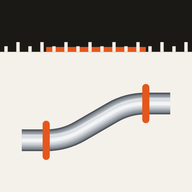
Enter each bend on the pipe: its type, where it goes from the end, its depth or height and angle. You get every mark from the same end, with earlier bends' shrink already added.
Enter your measurements
Mark 1 (bend 1, 1A)
24in
Exact geometry
- Mark 2 (bend 1, 1B)
- In the app
- Mark 3 (bend 2, 2)
- In the app
- Total shrink
- In the app
Every result is in Truemark
The free web version shows the main result and the drawing. Truemark gives you every mark and measurement, and exports a cut sheet. It is free to download.
- Every mark is measured from the same end of the pipe; earlier bends' shrink is already added.
How to lay it out
List the bends in order
Enter each bend on the pipe with its type and where it has to land, measured from the same end of the pipe.
Measure once from the end
Hook your tape on that end and mark every mark at the distance shown. The marks are in order along the pipe.
Bend from the end you measured
Bend the bends in order from that end, using the marks for each bend.
Check for overlapping bends
If the page warns that marks interleave, two bends sit on the same piece of pipe. Move one of them before you bend.
Good to know
- Every mark is measured from the same end of the pipe; earlier bends' shrink is already added.
- FabLayout runs the same code as Truemark; the result is exact geometry.
- Source: Plane trigonometry; same calculation as the Truemark app
Method and formula
A single stick often carries an offset, a saddle, a kick and a stub. Working out each bend on its own and adding the numbers by hand goes wrong because shrink adds up: every bend shortens the pipe and moves every mark after it.
- The bends are sorted by position from the end.
- Each bend's marks are placed at its position plus the shrink of all earlier bends.
- Total shrink = the sum of every bend's shrink.
- A stub-up is measured from the end of the pipe by its own take-up, not from its position in the layout.
There is no new geometry: each bend uses the same offset, saddle, kick or stub math as its own calculator, shifted by the shrink that has built up before it.
Worked example
The page defaults: a 6″ offset at 30° placed 24″ from the end, then a 4″ kick at 30° placed 72″ from the end. The offset marks are 24″ and 36″. The offset's shrink of 1.6077″ moves the kick mark to 73.6077″. The total shrink is 1.6077 + 1.0718 = 2.6795″.
Questions
Why are my marks further along than where I want the bends?
Each bend shortens the pipe. To land a later bend where you want it on the finished run, its mark has to move by the shrink of every bend before it.
What does the interleave warning mean?
Two bends' marks overlap on the pipe, so the pipe would have to bend twice in the same place. Move one bend further along.
Why does the stub ignore its position?
A stub-up is always measured from the end of the pipe by the take-up, so its mark depends on the stub height, not on where it sits in the list.
Similar calculators
More in TruemarkOffsetOffset from end3-point saddleSee what the app does