Conduit offset from the end calculator
Enter the offset depth, the bend angle and the distance from the pipe end to the bend that has to land on a fixed point. You get both marks measured from the end of the pipe.
Enter your measurements
First mark from the end
36in
Exact geometry
- Second mark from the end
- In the app
- Distance between marks
- In the app
- Shrink
- In the app
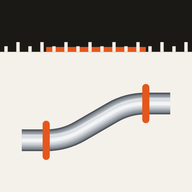
Every result is in Truemark
The free web version shows the main result and the drawing. Truemark gives you every mark and measurement, and exports a cut sheet. It is free to download.
How to lay it out
Decide which bend is fixed
Pick the bend that must land at a set distance: the near bend, closest to the pipe end, or the far bend, where the offset has to clear an obstruction or meet a box.
Measure from the pipe end
Square the end of the conduit and measure from it to where that bend has to sit. Enter it as the distance from pipe end.
Mark both bends from the end
Measure the first mark and the second mark from the same end and wrap each mark right around the pipe. For the far bend the shrink is already added.
Bend the offset
Bend at the first mark, roll the conduit 180° and bend at the second mark to the same angle, keeping both bends in one plane.
Good to know
- FabLayout runs the same code as Truemark; the result is exact geometry.
- Source: Greenlee Textron, Site-Rite Hand Bender Instruction Manual, IM 1071 Rev 4, offset table, p. 5 (offset geometry); the end reference is the same calculation as the Truemark app
Method and formula
This is an ordinary offset with the marks counted from the end of the pipe instead of from each other. The geometry does not change; only the reference moves.
- Distance between marks = offset depth ÷ sin θ.
- Shrink = offset depth × tan(θ ÷ 2).
- Near bend fixed: the first mark is the distance you measured, and the second mark is one distance between marks further along.
- Far bend fixed: second mark = distance + shrink, first mark = second mark − distance between marks.
The shrink only moves the far case. The pipe shortens as the first bend is made, so on the straight pipe the marks sit one shrink further from the end than the point you measured on the finished run. The near bend is made before any shrink happens, so its mark stays where you measured.
Worked example
The page defaults: a 6″ offset with 30° bends, the near bend 36″ from the end. The marks are 6 ÷ sin 30° = 12″ apart, so the first mark is at 36″ and the second at 48″. The shrink is 1.6077″. Switch the fixed bend to the far one and both marks move one shrink further along the pipe.
Questions
When does the far bend need to be fixed?
When the offset has to finish at a known point, such as the edge of a box, a knockout or the far side of an obstruction. Measuring the far bend from the end without the shrink leaves the offset short by the shrink.
Do I still need to cut the pipe long?
No. Both marks are measured from the end you squared, so you can bend from a cut end without trimming afterwards. Measure from that same end for every mark.
Why does the near case ignore the shrink?
Shrink happens in the length of pipe between the two bends and beyond. The near bend is the first one made, so nothing has shortened between it and the end yet.
Similar calculators
More in TruemarkBack-to-back 90sCorner obstructionKickSee what the app does