Conduit around a column or corner obstruction
Enter the obstruction shape and size, the conduit and any clearance. You get the spacing for two 45° bends that take the conduit around the corner in place of one 90°.
Enter your measurements
Corner to first mark
10 1/16in
Exact geometry
- Mark spacing
- In the app
- Back of conduit to corner
- In the app
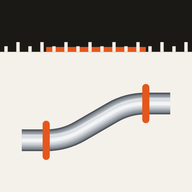
Every result is in Truemark
The free web version shows the main result and the drawing. Truemark gives you every mark and measurement, and exports a cut sheet. It is free to download.
- Two 45° bends in place of one 90°; the diagonal clears the obstruction.
How to lay it out
Measure the obstruction
Measure the diameter of a round column or pipe, or both sides of a box, sitting in the corner the conduit has to turn.
Choose the conduit and clearance
Pick the conduit you are bending and add any clearance you want between the conduit and the obstruction.
Mark the first 45°
Measure the corner-to-first-mark distance back from the corner along the first leg and wrap the mark.
Mark the second 45°
Measure the mark spacing from the first mark for the second mark.
Bend both 45s
Bend both marks to 45° in the same direction, in one plane, so together they turn the run 90°.
Good to know
- Two 45° bends in place of one 90°; the diagonal clears the obstruction.
- FabLayout runs the same code as Truemark; the result is exact geometry.
- Source: IBEW Local 903 Bending Book rev 2, “To Find Centers of 45° bends with Square / Rectangular / Round Obstruction” (field multipliers 1.414, 2.4 and × 3)
Method and formula
When a column, pipe or box sits in the corner where the conduit turns, a single 90° will not clear it. Two 45° bends chamfer the corner instead, and the diagonal between them runs tangent to the obstruction. The angle is fixed: two equal bends that add to 90° are 45° each.
- Back of conduit to corner: (A + B) × 1.414 for a box, diameter × 2.414 for a round obstruction, side × 3 for a square box turned on its corner. Every 1″ of clearance adds 2″.
- Mark spacing = back of conduit − 0.414 × conduit outside diameter, because the marks go on the centre line.
- Corner to first mark = mark spacing ÷ 1.414.
Field books round these to 1.414, 2.4 and × 3 with ½ the outside diameter deducted. This page uses the unrounded values. If the conduit sits on standoffs, subtract the standoff depth from A and B.
Worked example
The page defaults: a 6″ round column, ½″ EMT, no clearance. Back of conduit to corner is 6 × 2.414 = 14.4853″. Deducting 0.414 × the EMT outside diameter gives a mark spacing of 14.1928″, and the first mark is 10.0359″ from the corner.
Questions
Why two 45s and not a 90?
A 90° bend follows the corner tightly and runs into anything sitting in it. Two 45s cut across the corner on a diagonal that clears the obstruction.
Why deduct part of the conduit diameter?
The layout is measured to the back of the conduit, but bend marks go on its centre line. Moving all three lines in by half the diameter shortens the diagonal by 0.414 × the outside diameter.
How much does clearance add?
Every 1″ of clearance between the conduit and the obstruction adds 2″ to the back-of-conduit measurement.
Similar calculators
More in TruemarkStub-upBack-to-back 90sKickSee what the app does