Matching an existing conduit offset
Measure an offset that is already installed: the length between its bends and the rise. You get the bend angle, the nearest bender mark, the shrink and the mark spacing for the new pipe.
Enter your measurements
Bend angle
30.00°
Exact geometry
- Nearest bender mark
- In the app
- Shrink
- In the app
- Mark spacing at the bender mark
- In the app
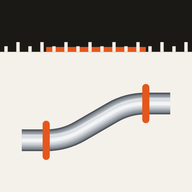
Every result is in Truemark
The free web version shows the main result and the drawing. Truemark gives you every mark and measurement, and exports a cut sheet. It is free to download.
How to lay it out
Measure the old offset
Measure the length between the two bends along the slanted piece, and the rise between the two runs.
Measure to the same point
Measure both bends from the same point on the pipe: both centres or both outer edges.
Read the angle
Enter both numbers. If the angle is within 0.25° of a bender mark, use that mark; otherwise bend to the exact angle with a protractor.
Mark and bend the new pipe
Mark the new pipe at the mark spacing shown and bend both marks to that angle, so the new offset matches the old one.
Good to know
- FabLayout runs the same code as Truemark; the result is exact geometry.
- Source: Derived from the offset formula (distance between marks = depth ÷ sin θ) in Greenlee Textron, Site-Rite Hand Bender Instruction Manual, IM 1071 Rev 4, offset table, p. 5; no manufacturer publishes a separate matching-bends rule
Method and formula
To run a new pipe alongside an existing offset you need its angle, which nobody wrote down. Turning the offset formula around gives the angle from two measurements.
- Bend angle = arcsin(rise ÷ length between bends).
- Mark spacing = rise ÷ sin(angle).
- Shrink = rise × tan(angle ÷ 2).
The angle snaps to a standard bender angle (10°, 22½°, 30°, 45° or 60°) only when it is within 0.25° of it. Further away, bend to the measured angle with a protractor. This rule is derived by inverting the published offset formula; no manufacturer publishes a separate matching rule, so test it on a scrap piece first.
Worked example
The page defaults: 12″ between the bends and a 6″ rise. The angle is arcsin(6 ÷ 12) = 30°, right on the 30° bender mark. The new pipe gets marks 12″ apart, and the shrink is 1.6077″.
Questions
What if the angle is not a standard bender angle?
When it is more than 0.25° away from 10°, 22½°, 30°, 45° or 60°, bend to the exact angle shown and check it with a protractor or an angle finder.
Why measure both bends from the same point?
Measuring one bend at its centre and the other at its edge changes the length between them, and the angle with it. Use the same point on both.
Can the rise be larger than the length between bends?
No. That would need a bend of 90° or more. Check the measurement: the rise is always shorter than the slanted length.
Similar calculators
More in TruemarkStub-upBack-to-back 90sCorner obstructionSee what the app does