Parallel kick calculator
Enter the number of pipes, the bend angle, the mark on the first pipe, the kick height and the spacing. You get the kick mark from the end for every pipe in the run.
Enter your measurements
Pipe 1: mark from the end
24in
Exact geometry
- Pipe 2: mark from the end
- In the app
- Pipe 3: mark from the end
- In the app
- Travel
- In the app
- Shrink
- In the app
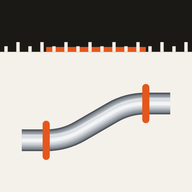
Every result is in Truemark
The free web version shows the main result and the drawing. Truemark gives you every mark and measurement, and exports a cut sheet. It is free to download.
How to lay it out
Square the pipe ends
Cut all pipes square and line them up at the reference end.
Mark the outer pipe
Mark the outer pipe at the mark you entered. It is the reference.
Mark each pipe inward
Mark each next pipe inward closer to the end than the one before, at the mark shown for that pipe.
Bend the kicks
Bend every pipe to the same angle at its own mark, so the kicks nest with even spacing.
Bend the 90s separately
These marks cover the kick only. A 90° bend after the kick needs its own marks.
Good to know
- FabLayout runs the same code as Truemark; the result is exact geometry.
- Source: ToolGrit conduit bending guide (shift = spacing × tangent of half the bend angle)
Method and formula
When a rack of conduits kicks together, each pipe's kick has to start a little earlier than the one outside it, or the run pinches at the bend. The geometry is the same as for parallel offsets.
- Shift = centre-to-centre spacing × tan(θ ÷ 2), added up pipe by pipe from the outer pipe.
- Mark for each pipe = mark on the outer pipe − its shift.
- Travel = kick height ÷ sin θ and shrink = kick height × tan(θ ÷ 2), for the reference pipe.
The calculation assumes square-cut pipe ends lined up at the reference end. If the last pipe's mark would fall before the end of the pipe, the page says so.
Worked example
The page defaults: 3 pipes 2″ apart, a 4″ kick at 30°, with the outer pipe marked at 24″. The shift is 2 × tan 15° = 0.5359″ per pipe, so the marks are 24″, 23.4641″ and 22.9282″ from the end. The travel is 8″ and the shrink 1.0718″.
Questions
Why is the outer pipe the reference?
The outer pipe has the longest path round the kick. Each pipe inside it turns on a smaller path, so its kick starts closer to the end.
Do the 90s after the kick shift too?
They need their own marks. These results cover the kick bend only.
Can the pipes have different spacings?
Yes in principle: the shift for each gap is that gap × tan(θ ÷ 2), and the shifts add up. This page uses one equal spacing.
Similar calculators
More in TruemarkStub-upBack-to-back 90sCorner obstructionSee what the app does